
How to Read a Clock
The ultimate, comprehensive guide to understanding analog clock faces, deciphering the hands of time, and mastering the 24-hour format.
Why Read an Analog Clock in the Digital Age?
In today's hyper-digital world, we are constantly surrounded by glowing screens—our smartphones, microwaves, computer monitors, and smartwatches all flash the time at us in highly precise, digital numbers. With "14:32" or "2:32 PM" instantly available at a glance, you might wonder: why do we still need to learn how to read a traditional analog clock?
The answer goes far beyond simple nostalgia. An analog clock face provides a visual, geometric representation of time that a digital readout simply cannot match. When you look at an analog clock, you don't just see what time it is now; you instantly see how much time has passed, and how much time remains until a future event. It visualizes time as a pie chart, helping the human brain conceptualize duration and deadlines much more effectively than a blinking number.
Furthermore, analog clocks remain a staple of professional environments, train stations, luxury watches, and classical architecture worldwide. Knowing how to quickly and accurately read a clock face is a foundational life skill. Whether you are helping a child learn to tell time for the first time, or you simply want a refresher on the mechanics of timekeeping, this comprehensive guide will break down everything you need to know.
1. The Anatomy of the Clock Face
Before we look at the hands, we must understand the canvas they spin on. The standard analog clock face is a perfect circle divided into exactly 12 primary, evenly-spaced sections. These sections are labeled with the numbers 1 through 12. These numbers represent the 12 hours that make up half of a standard Earth day.
If you look closely between these large numbers, you will notice smaller tick marks. These tiny lines represent individual minutes. Because there are 60 minutes in a single hour, there are exactly 60 tick marks wrapping around the entire perimeter of the clock. Every large number acts as a milestone representing a 5-minute increment. For example, the space between the 12 and the 1 contains 4 small ticks, with the number 1 acting as the 5th tick.
2. Deciphering the Three Hands of Time
To tell the time, you need to understand the function of the hands spinning from the center axis. Most standard clocks have two hands, while more precise clocks include a third.
- The Hour Hand (The Short Hand)This is the shortest, thickest hand on the clock. It moves incredibly slowly, taking a full 12 hours to complete one 360-degree revolution. Whichever large number this hand is pointing directly at—or has most recently passed—is the current hour. If the short hand is halfway between the 3 and the 4, the hour is 3.
- The Minute Hand (The Long Hand)This hand is significantly longer and usually thinner than the hour hand. It moves faster, taking exactly 60 minutes to complete one revolution. We do not read the large numbers directly for this hand; instead, we use them as a map to count the minutes.
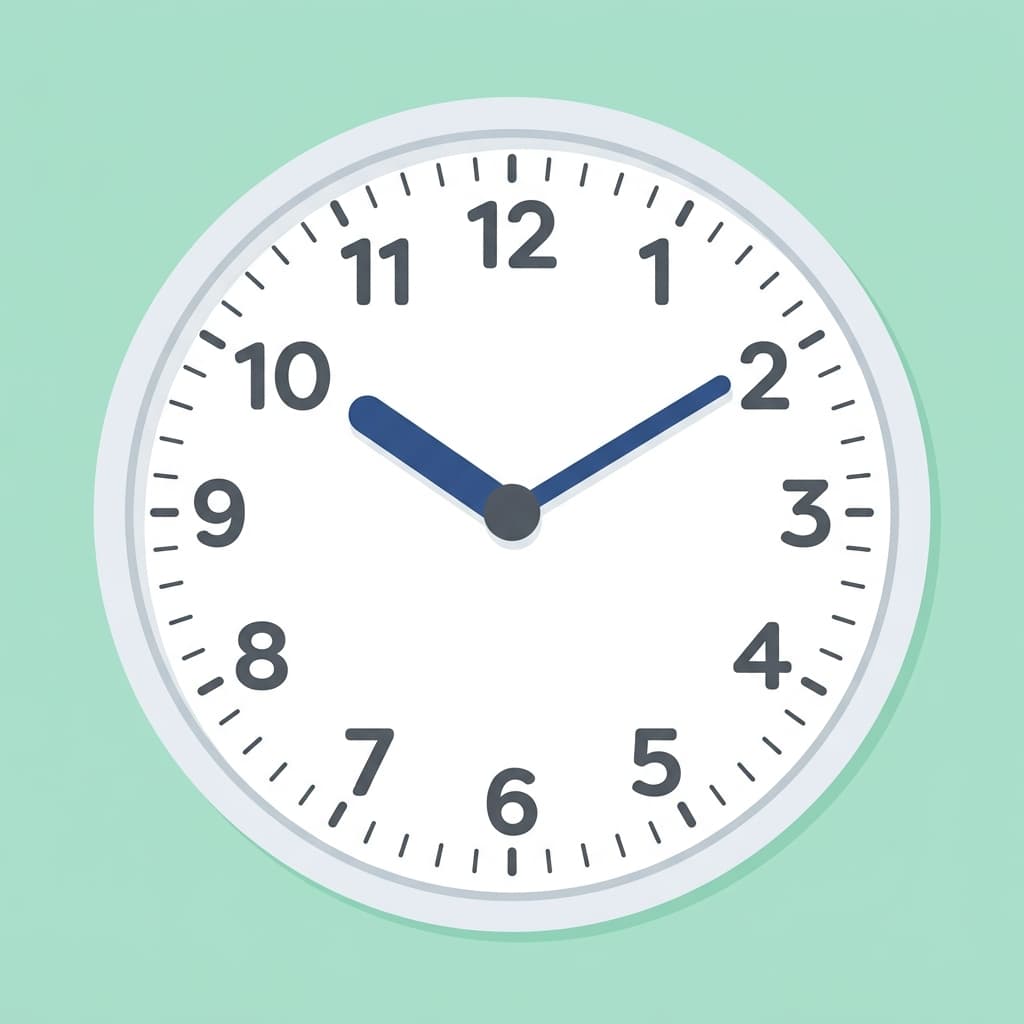
Notice how the thick, short hand points to the hour, while the long hand extends to the minute markers.
3. The 5-Times Table Trick (Reading Minutes)
Reading the hour hand is straightforward, but reading the minute hand often trips beginners up. Because the numbers 1 through 12 on the clock face are used for both hours and minutes, you have to do a little bit of mental math to determine the minutes.
The secret is the Multiply by 5 trick. Because the distance between every large number on the clock is exactly 5 minutes, you simply multiply the number the minute hand is pointing to by 5.
- If the long hand points to 1: 1 x 5 = 05 minutes past the hour.
- If the long hand points to 3: 3 x 5 = 15 minutes past the hour (a quarter past).
- If the long hand points to 6: 6 x 5 = 30 minutes past the hour (half past).
- If the long hand points to 9: 9 x 5 = 45 minutes past the hour.
If the long hand is pointing somewhere between the large numbers, simply find the nearest number it just passed, multiply by 5, and count the remaining small tick marks. For example, if it is two tick marks past the 4, you calculate (4 x 5) = 20, plus 2 ticks = 22 minutes.
4. Dealing with Roman Numerals
As you encounter older, antique, or highly stylized luxury clocks (like the famous Big Ben in London), you will likely run into Roman Numerals instead of standard Arabic numbers (1, 2, 3). Don't panic! The positions of the numbers never change, so you can still read the clock entirely by spatial memory.
However, if you want to understand the symbols, here is a quick cheat sheet for the clock face:
Fun fact: Many traditional clockmakers use "IIII" instead of "IV" for the number 4. This is a centuries-old tradition known as the "Watchmaker's Four," designed to create visual symmetry with the "VIII" on the opposite side of the dial!
5. AM vs. PM and Military Time
Because a standard analog clock only displays 12 hours, it must complete two full rotations to account for the 24 hours in a full day. The first rotation covers the morning (AM), and the second rotation covers the afternoon and evening (PM).
- AM (Ante Meridiem): Translates from Latin as "Before Midday." This covers the time from midnight up to 11:59 in the morning.
- PM (Post Meridiem): Translates as "After Midday." This covers noon up to 11:59 at night.
The major limitation of an analog clock is that it cannot explicitly tell you if it is AM or PM—you simply have to look outside or use contextual clues!
The 24-Hour Format
In many parts of Europe, Asia, and in global professions like medicine, aviation, and the military, the 24-hour time format is the standard. Instead of resetting to 1:00 after noon, the clock continues counting upwards to 13:00, 14:00, and eventually 23:59.
To quickly convert an afternoon PM time to 24-hour time, simply add 12 to the hour. For example, 3:00 PM + 12 = 15:00. To reverse the process, subtract 12 from any number higher than 12.
6. Tips for Teaching Children
If you are a parent or educator trying to teach a child how to read an analog clock, patience is key. Time is a highly abstract concept for young minds. Here are the best strategies to make it stick:
- Start with the Hour Hand only: Ignore the minutes entirely at first. Ask the child "Where is the short hand pointing?" Help them understand that if it is between the 4 and the 5, it is still "four-something" because it hasn't reached the 5 yet.
- Master the 5-times tables: Before introducing the minute hand, ensure the child is comfortable counting by 5s (5, 10, 15, 20). This makes calculating the minutes much less intimidating.
- Use physical props: Buy a cheap plastic clock with physical gears where moving the minute hand automatically moves the hour hand. Letting them physically feel how the two hands are connected mechanically makes the concept click instantly.
Ready to test your skills?
The best way to learn how to read a clock is by practicing with a real, moving analog face. We've built a beautiful, free, digital analog clock that runs in real-time. Give it a look and see if you can decipher the exact time!
Open the Online Analog Clock